
01
Physical literacy
Balance, coordination, spatial awareness and the ability to fall without hurting themselves. These underpin every other sport they'll ever try.
Ages 5–15
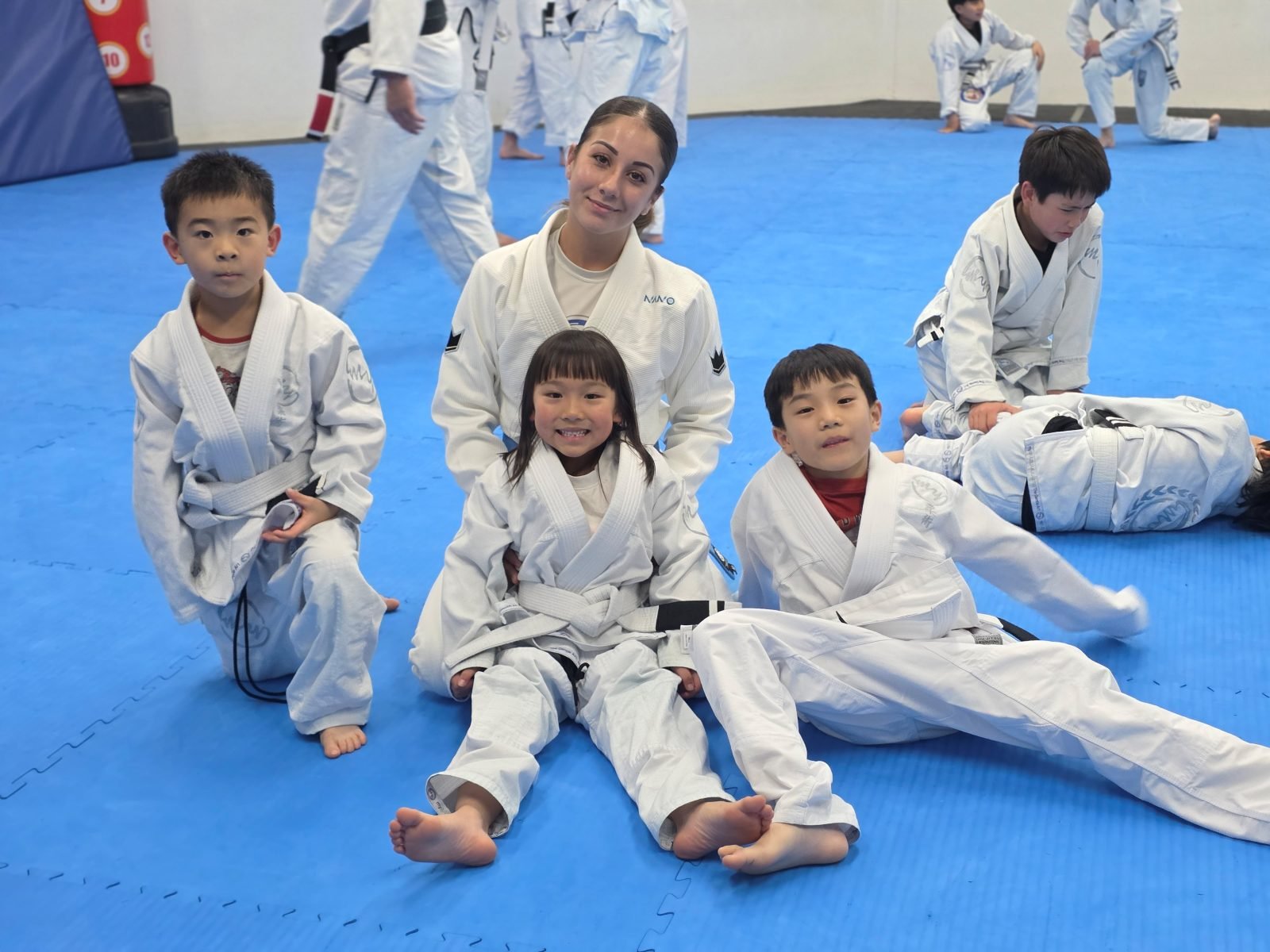
Brazilian Jiu-Jitsu for children in Carlingford. No punching, no kicking — they learn control, composure and how to look after themselves and each other.
When they train
There is no separate kids-only session. Children, teenagers and adults train together, with Toshi pairing people by size and experience.
372 Pennant Hills Road, Carlingford NSW 2118
Mon & Thu · All Levels · 7:00–8:30 pm
INRG myBJJ — free with your membership
Tue · BJJ, all ages · 6:30 pm
Growing up on the mat
Children learn movement differently to adults. Falling safely, bridging out from under someone's weight, keeping their head off the floor — at eight years old these go in as motor memory, the same way riding a bike does.
The difference shows up a decade later. A teenager who has been grappling since primary school isn't just more capable in a physical situation. They're calmer in one. They've been in a hundred uncomfortable positions on a mat, worked out that panicking makes it worse, and learned to breathe and problem-solve instead. That transfers to far more than fighting.
It also happens to be the only martial art where a child can practise at genuinely full effort against a resisting partner, every week, without anyone getting hit.
Why it lasts
Belts and trophies are the visible part. These are the ones parents notice at home and at school.
Balance, coordination, spatial awareness and the ability to fall without hurting themselves. These underpin every other sport they'll ever try.
Jiu-jitsu is a physical puzzle with a person actively resisting your solution. Children learn to think while uncomfortable — a rarer skill than it sounds.
They will get stuck, escape, and get stuck again, every session. Losing safely and often is how a child stops being afraid of losing.
Posture, eye contact and calm are read instantly by other children. Most bullying stops being aimed at a child long before any physical skill is needed.
Being underneath someone is stressful. Learning to breathe, slow down and work the problem instead of thrashing is a lesson that follows them into exam rooms.
Bowing onto the mat, shaking hands after every round, listening without interrupting. Not because it's traditional, but because the training doesn't work otherwise.
An hour of hard physical activity they actually want to attend, plus the hygiene routine that comes with a shared mat — short nails, clean uniform, wash after training.
Belt progression in jiu-jitsu is measured in years, not weeks. Children learn what sustained effort towards a distant goal actually feels like.
A training partner is not a teammate or an opponent — they're both. Children build unusually strong friendships across ages and schools on a mat.
The end point of all of it: knowing what your body can do, and having the self-control not to need to prove it.
The context
This comes up in almost every conversation we have with parents.
Most parents who call us aren't looking for a sport. They're looking for something to do about a child who has come home flat, or gone quiet about school.
That last number is the one we care about most. It isn't about your child fighting — it's about your child being the one with enough composure to say something. Jiu-jitsu builds that from the ground up, because the whole art is designed around leverage rather than force: a smaller person really can control a larger one, and a child who knows that in their body carries themselves differently.
The most useful thing jiu-jitsu does for a bullied child happens before anyone touches anyone.
When a child genuinely can't leave, jiu-jitsu offers something no striking art can: a way to end a physical situation without hurting anyone.
The advantage
Teach a child to punch and you've given them one tool: hurting someone.
A child who hits back
A child who controls
Close the distance. Hold them still. Wait for a teacher.
That's what "the gentle art" means in practice.

Enrol
Come and watch a full session before you commit to anything. Parents are welcome to stay on the sidelines — nothing here happens behind a closed door.
Your child needs a t-shirt and shorts or trackpants with no pockets or zips, a labelled drink bottle, and short nails. A parent or guardian signs the health form and waiver at the desk, which takes a couple of minutes.
Your child's age, any medical conditions or injuries, and which nights suit you.
Underground and outdoor parking right outside at Carlingford Village. Seating at the edge of the mat — stay for the whole session.
Safety, coach checks and what happens on a first night are all on the FAQ.