Most people who are curious about jiu-jitsu spend months not starting. Not because it's expensive, and not because they can't find a gym — Sydney has plenty. They don't start because they can't picture the first hour, and the imagination fills the gap with something worse than the reality.
So here is the first hour, plainly. It's broadly the same at any decent academy, in Carlingford or anywhere else.
You arrive, and it's quieter than you expected
A jiu-jitsu gym before class doesn't look like a fight scene. People are sitting on the mat stretching and talking about work. Somebody's kid is doing homework in the corner. It smells of disinfectant, because good gyms mop the mat between every session.
Take your shoes off before you step anywhere near the mat — this is the one rule you'll be corrected on immediately if you forget, and it exists because skin infections are the main health risk in grappling.
Nobody expects you to know anything
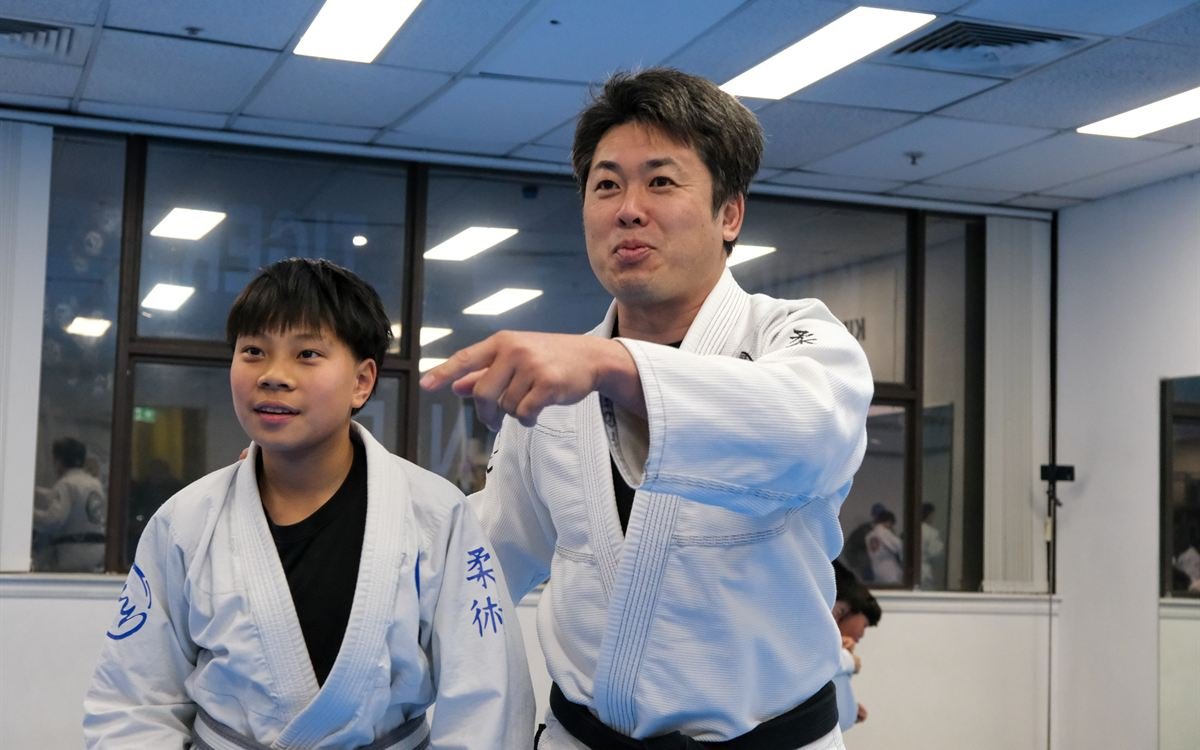
The instructor will ask if you've trained before. Say no. That's the answer that makes their job easier, not harder — it tells them to pair you with someone reliable and to explain the grips rather than assuming.
The fastest way to have a bad first class is to pretend you know more than you do.
The warm-up is the bit people fear, and it's not the hard bit
Ten minutes of shrimping, bridging, rolling backwards, and some light cardio. You will be worse at it than everyone else in the room, and no one will notice, because they were all worse at it than everyone else once too.
If you need to stop, stop. Walking off for water halfway through a warm-up is completely unremarkable, and no coach worth training under will comment on it.
Then somebody shows you one thing
The technique section is fifteen to twenty minutes. You'll be shown one position — say, escaping from underneath side control — and two or three details that make it work. You will forget most of it by the car park. That's the normal outcome, not a failure.
What you're really learning in month one isn't technique. It's how to be comfortable with someone's weight on you without panicking. Everything else is built on that.
You drill it slowly, with a real person
Drilling means taking turns. Your partner lets you do the move, you let them do the move. There's no resistance and no winner. Talk to them — ask them to go slower, ask them to check whether your hand is in the right place. Experienced training partners actively like being asked; it's how they check that they understand it themselves.
Then you roll
Class finishes with live rounds, and you'll be in them. On a first night you'll be paired with someone senior whose entire job for that round is to make sure you have a good time — not to beat you.
And if at any point you don't like where a round is going: you tap. Two firm taps, and it stops instantly. That mechanism is the reason a grappling art can be practised at full speed for decades without people getting hurt.
Then it's over and you feel great
The class lines up, bows out, and everyone shakes hands. You'll be more tired than an hour of exercise should make you, because you spent most of it tense. That improves within about three weeks.
A fair number of people who walk out of a first class say the same thing: that was much less frightening than I'd built it up to be. The build-up is the hard part. The class is just an hour.
We run beginner-friendly All Levels classes in Carlingford on Monday and Thursday nights, and the first one is free. If you want the full minute-by-minute version, including what to wear and the hygiene rules, read your first class.