Brazilian Jiu-Jitsu has fewer belts than most martial arts, and each one takes longer to earn. That surprises people. Here's how the system works, what the stripes mean, and how long it really takes.
The short answer
Adults go white, blue, purple, brown, black. Kids under 16 have their own set of colours in between. Small stripes on the belt mark progress inside each colour. And your instructor decides when you move up. There's no exam you book in for.
The adult belts, in order
From 16 years old, everyone trains in the adult system. The International Brazilian Jiu-Jitsu Federation (IBJJF) sets the standard most academies follow, including minimum ages and minimum time spent at each belt before the next one.
| Belt | What it usually means | Typical time at this belt |
|---|---|---|
| White | Learning to survive, escape and stay calm underneath | 1.5–3 years |
| Blue | Solid fundamentals and a defence you can trust. Minimum age 16 | 2–3 years |
| Purple | A game of your own; often starts helping teach. Minimum age 16 | 1.5–3 years |
| Brown | Refining and joining it all up. Minimum age 18 | 1–2 years |
| Black | A full understanding of the art. Minimum age 19 | A lifetime, with degrees added over decades |
Add those up and black belt usually lands somewhere around ten years of consistent training. Our head instructor, Toshi Miyazawa, started under Professor Mario Sergio Yokoyama in 2008 and was awarded his black belt in 2024.
What the stripes mean
Between belts there's a long stretch, so stripes break it into smaller steps. They're pieces of white tape wrapped around the black bar at the end of the belt (on a black belt, the bar is red). Most academies give up to four stripes on each belt. After the fourth comes the next colour, though not automatically.
A stripe tells you that you're heading the right way. It doesn't come on a timer. Some months you'll get one; some years you'll feel stuck. Both are normal.
The kids belts, in order
Children progress faster in some ways and slower in others, so under-16s use a separate set of colours. After white, each colour is split into three steps: with a white bar, solid, then with a black bar.
- White: everyone starts here
- Grey: grey-white, grey, grey-black
- Yellow: yellow-white, yellow, yellow-black
- Orange: orange-white, orange, orange-black
- Green: green-white, green, green-black
Kids collect stripes too, and the small wins matter a lot at that age. At 16 they move across to the adult system, usually at blue belt if they've trained for a few years.
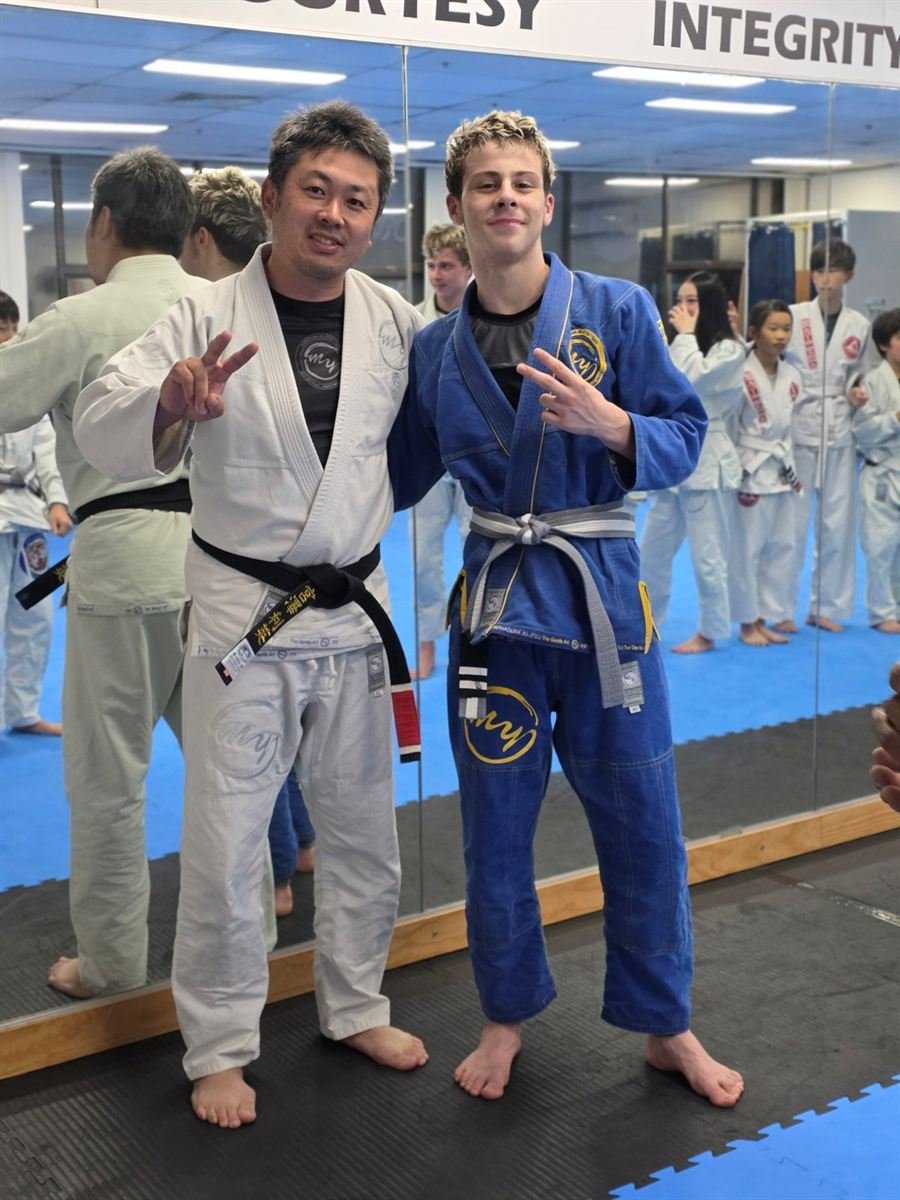
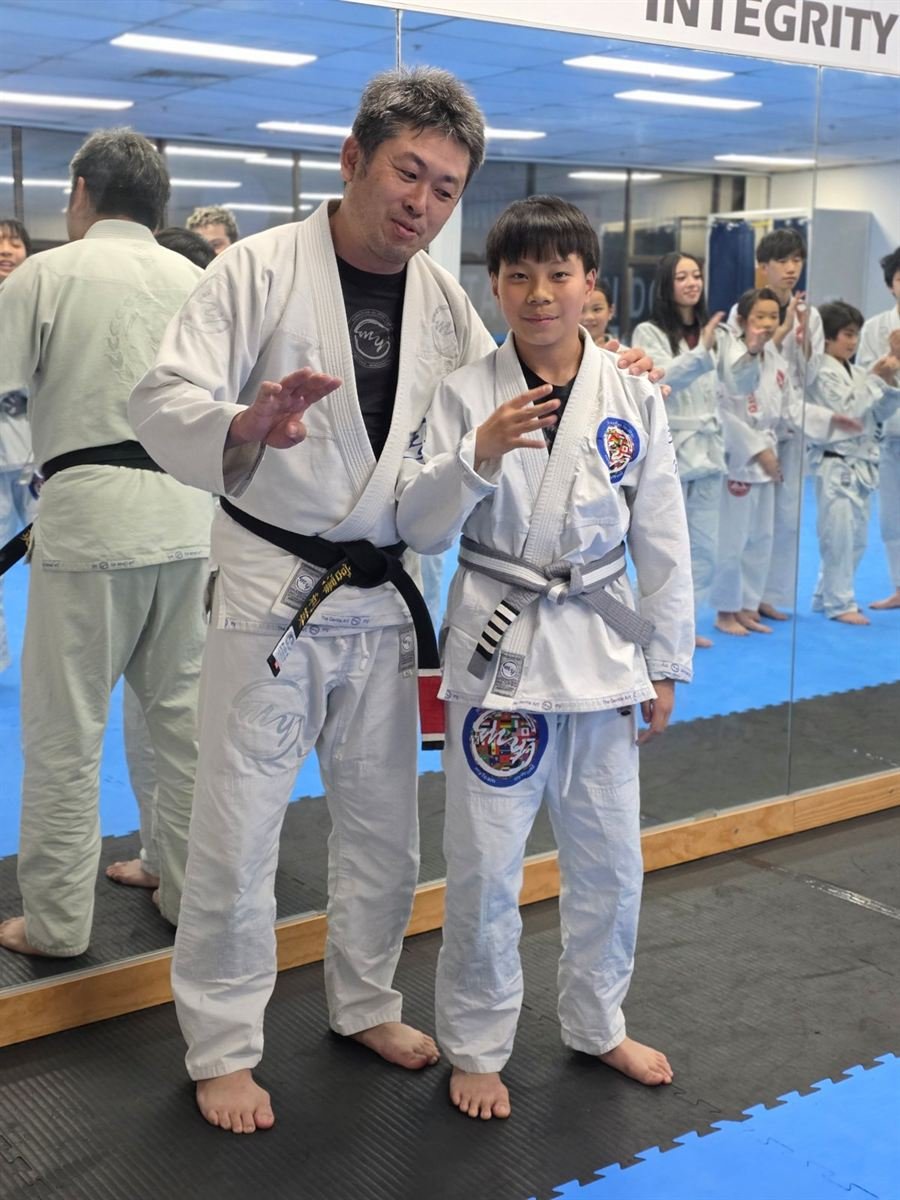
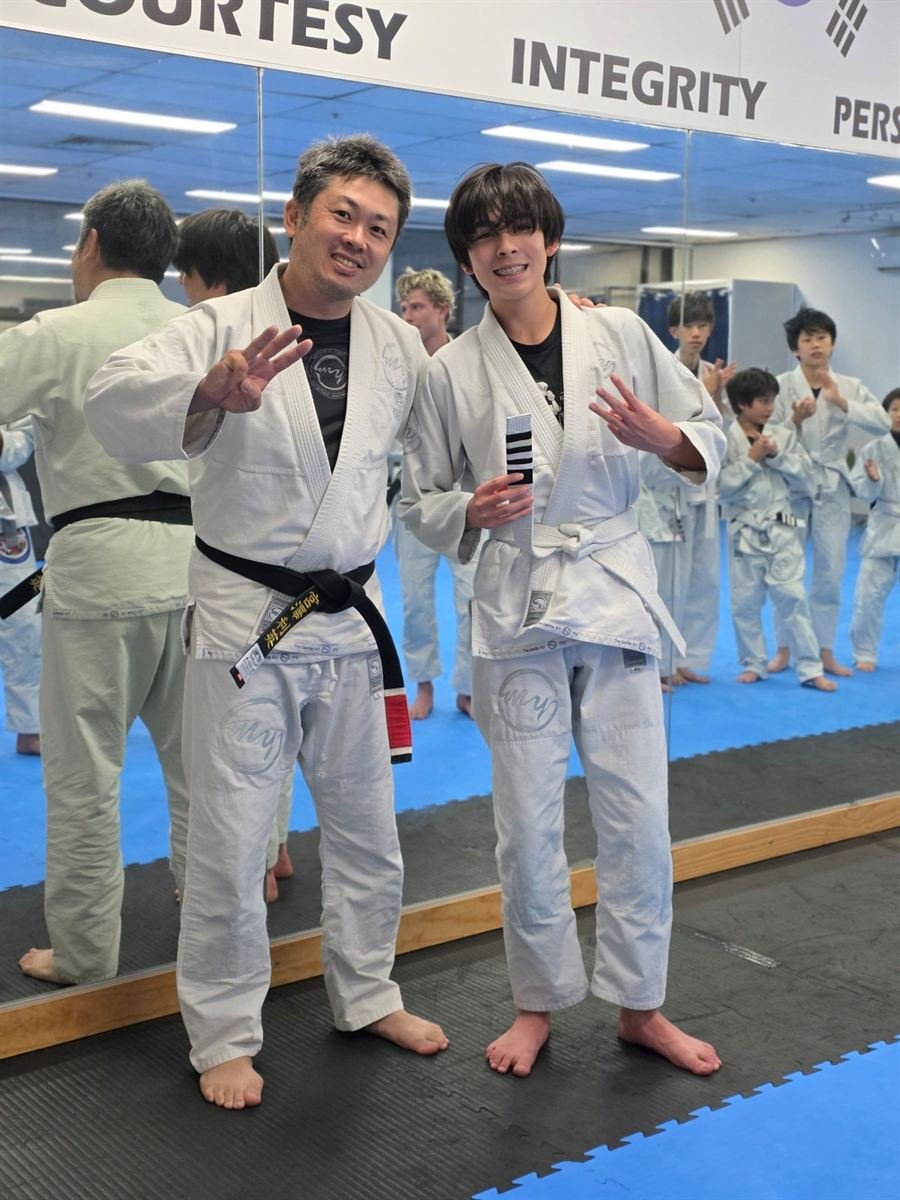
Grading night at Carlingford, October 2026.
How long until my first promotion?
For an adult training two or three times a week, a first stripe often comes within the first few months, and blue belt typically within one and a half to three years. Training once a week roughly doubles that. Gaps in training aren't a problem. You keep what you've learned, it just takes a few sessions to come back.
The honest answer is that it depends far more on how often you come than on talent. The people who get there are the ones who kept showing up.
How promotions work at myBJJ Miyazawa
Every belt and stripe at the academy is awarded by Toshi, based on what he sees on the mat over time, not on one good night. He looks at:
- Consistency. How regularly you train, over months rather than weeks.
- Technique. Whether you can do the fundamentals for your belt correctly, under some pressure.
- How you roll. Not whether you win, but whether you're making good decisions.
- How you treat people. A good training partner is part of the standard, not an extra.
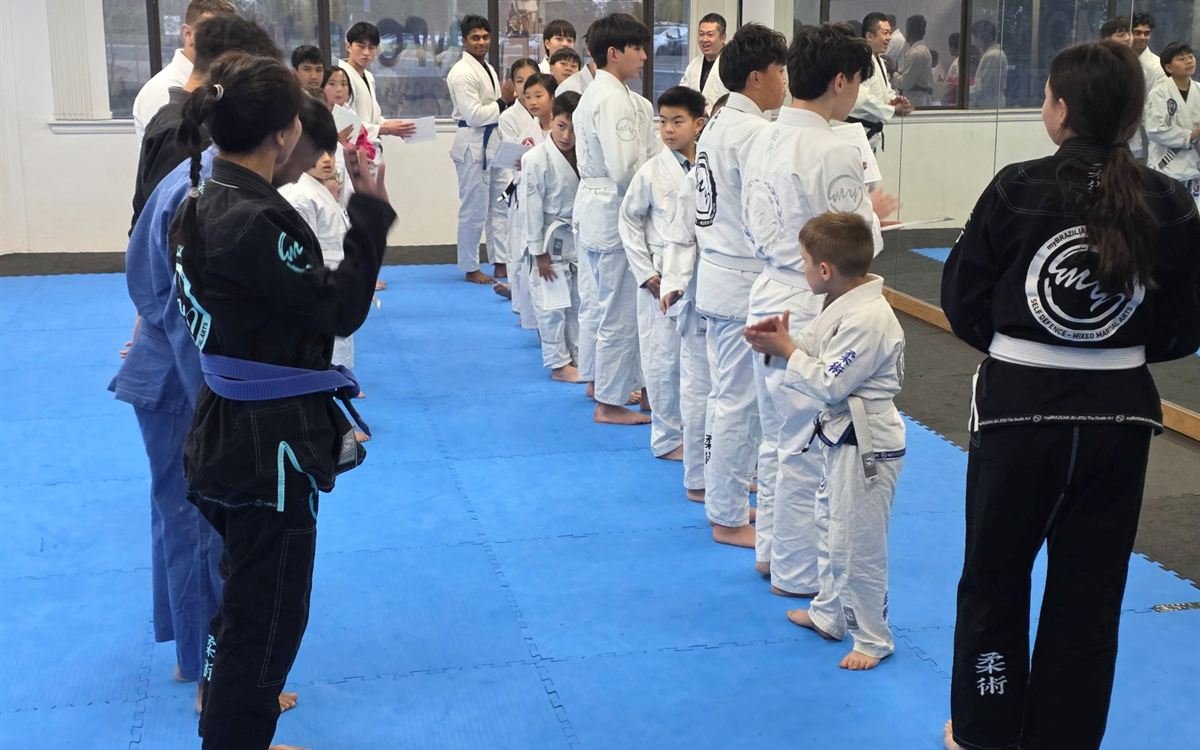
Promotions are presented in front of the whole class, and everyone gets a photo with their instructor. It's one of the best nights on the calendar. You can see the last one in our gallery.
A belt covers two inches of your waist. The rest is up to you.
We're part of the myBJJ Team, so the standard on our mat matches every other myBJJ academy, from Sydney to Japan.
Do belts matter if I just want to train?
No. Plenty of people never think about rank and still train for years. But belts do one useful job for a beginner: they show you that progress is happening when it doesn't feel like it. Most people never notice how much they've improved until a newer white belt asks them for help.
Everyone starts at white, and your first class is free. Read what happens at your first class, see the timetable, or have a look at our kids program for ages 5 to 15.